
What Laurel County Deeds Convey
Every recorded deed names the parties, the land, and the interest being passed. Look for an execution date and a recording date. Also note the consideration, signatures, certification, legal description, restrictions, and easements. Many deeds also cite the earlier conveyance they build upon. The deed type explains why the transfer happened. That label never settles every question of title.
| Deed form | Recorded function | Typical Laurel research use |
|---|---|---|
| General or special warranty deed | Conveys land with stated covenants | Follow an ordinary purchase or other transfer |
| Correction deed | Corrects a prior recorded instrument | Resolve a name, recital, or description change |
| Commissioner's or sheriff's deed | Conveys under court or official authority | Trace a court, foreclosure, estate, or tax process |
| Fiduciary or estate deed | Transfers through an authorized representative | Connect probate authority to the later grantee |
| Deed of restriction | Records restrictions tied to land | Review subdivision or use limits in the record |
Not every recorded item is a deed. Mortgages, liens, lis pendens notices, and judgments are encumbrances instead. A release shows that one of those claims was later discharged, which matters for a clean trail. Search the encumbrances alongside the conveyance itself.
Laurel Deed Room and eCCLIX
The Laurel County Clerk Recording and Deed Room keeps the county's land records. Visit at 101 S Main Street, Room 203, London, or call 606-864-5158. Remote work is possible too. The office offers eCCLIX online access. Registered users can view and print documents nearly around the clock, seven days a week. Anyone without an account may still inspect records at the office.
Online access sits behind a subscription. The sign-up form collects account details, contacts, a subscription period, user count, and chosen counties. Payment runs by mailed check, money order, or electronic invoice. Common cards are accepted. Frequent searchers get real value from that model. For one old instrument, a trip to the deed room often makes more sense.
The clerk's official records page is this overview of Laurel County land records access. It outlines both routes.
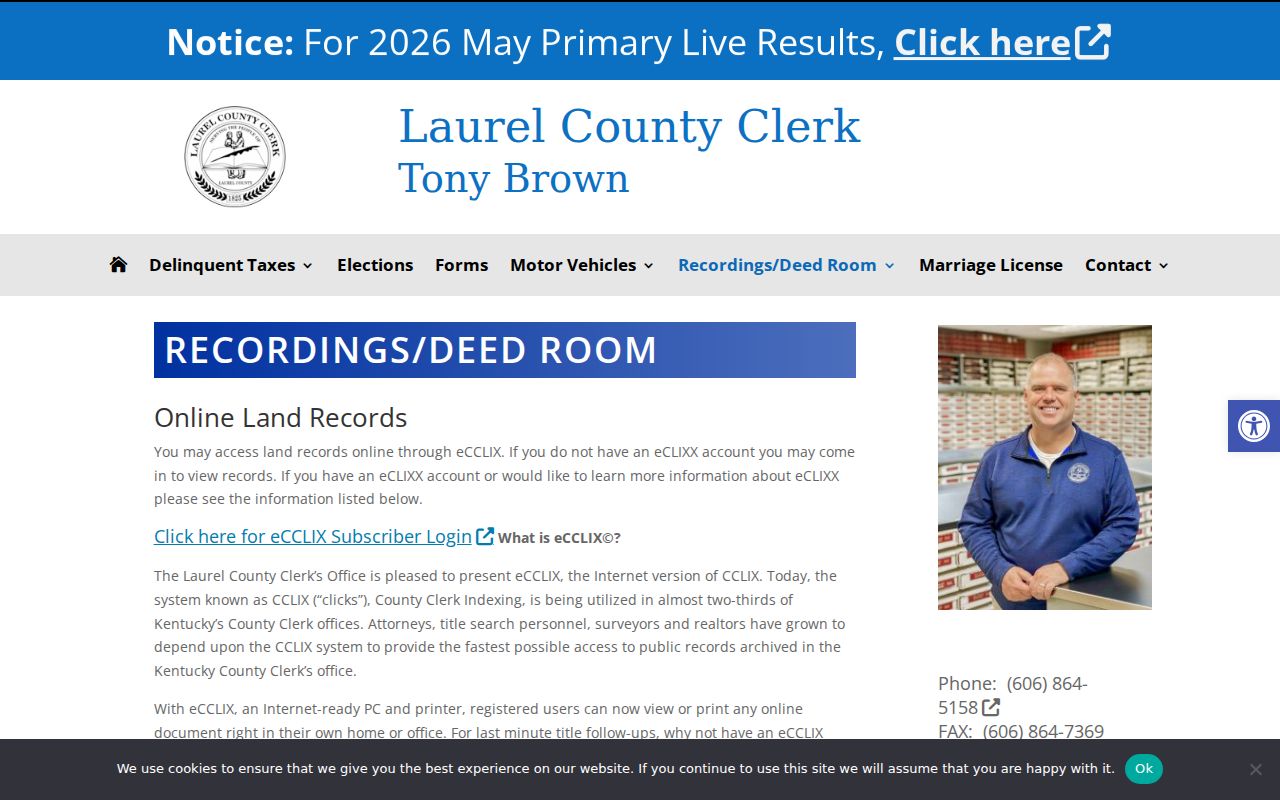
The page separates registered online access from in-office viewing, a useful fallback when the subscription path does not fit a one-time search.
Trace Laurel Grantors and Grantees
A grantor conveys the stated interest. A grantee receives it. The chain of title is the linked sequence of conveyances touching the same land. Start from a known recent deed, follow its prior-deed recital backward, and compare the legal description at each step rather than trusting names alone.
- Find the current acquisition deed with the present party shown as grantee.
- Copy its grantor, legal description, book/page, dates, and prior-instrument reference.
- Search that grantor as a grantee in the earlier period, trying spouse, initials, and spelling variants.
- Repeat through ordinary, commissioner, sheriff, fiduciary, correction, and restriction categories as the record requires.
- Move to office books, KDLA microfilm, tax lists, or parent-county records when the online trail ends.
- Grantor
- The party conveying the recorded interest.
- Grantee
- The party receiving the recorded interest.
- Chain of title
- The ordered series of conveyances tied to the same tract.
- Book and page
- The volume and page citation used to retrieve a recorded document.
The public screen does not spell out exact search labels, wildcard behavior, or coverage years. Run the grantor and grantee directions both ways. An online no-result never proves a deed is missing, so check again with the clerk.
Laurel Deed References Build the Chain
A book and page on a PVA sale row is only an index lead. Open the instrument, look for a prior conveyance recital, and compare tract descriptions. Lot and block, subdivision name, metes and bounds, acreage, roads, creeks, ridges, and survey calls can outlast a house number. They can also outlast a parcel number. Copy the source spelling exactly before inventing any modern search version.
A plat shows lot geometry, roads, rights-of-way, and subdivision labels. An easement can grant a right across land without conveying the fee estate. A restriction may limit use while ownership stays unchanged. Read each as its own recorded instrument and match its land description to the deed. GIS map lines help with context. But they never replace the recorded plat or a legal survey.
Older Laurel County Deed Records
The clerk site publishes no imaging cutover date or earliest online book. A Kentucky Department for Libraries and Archives deed handout describes a statewide deed-book era running from 1781 through 2018. Each county's coverage varies. Ask the clerk and KDLA which Laurel volumes, indexes, and microfilm you need. Give them the county and the approximate year. Include the names, the record type, and whether images or just index pages are required.
Selected Laurel tax lists survive for 1827 through 1831, 1833, 1835 through 1836, 1840 through 1855, and 1857 through 1875. A tax list can bridge a hard pre-1890 chain. It shows the taxpayer, acreage, district, value, and year. They support a deed search; they are not conveyances. Search several years, and return to the recorded deed whenever a name or acreage shift supplies a lead.
Note: Ask the clerk or KDLA about book gaps; no official source confirms any courthouse fire or wholesale land-record loss.
Before Laurel County's Formation
Laurel County formed in 1826 from territory tied to Clay, Knox, Rockcastle, and Whitley counties. A chain that seems to end near formation may continue in a parent county. Kentucky's Secretary of State Land Office also holds Virginia pre-statehood material. It holds Kentucky patent and warrant material as well. A patent records an early allocation; later county deeds record the conveyances that followed.
Work backward using stable tract clues from the earliest Laurel deed. These clues include watercourses, roads, adjoining owners, acreage, survey calls, and prior grant language. Then search the parent-county indexes and the patent databases for the earlier period. Formation history explains the jurisdiction shift. But it cannot prove that two similar descriptions cover the same tract of land.
Fees for Laurel Deed Records
Laurel County recording fees start at set minimums. A deed or plat costs $50 and a mortgage $80, while a correction deed, mortgage release, or certain liens runs $46. Extra-page charges kick in for marked categories. Those figures cover recording a new instrument, not the cost of retrieving an existing deed.
Copy charges work differently. Under KRS 64.012, a certified copy costs $5 plus 50 cents per page after three pages. The clerk's open-records policy lists ten cents per page for ordinary written copies and actual economical cost for other media. Ask which schedule applies. A written estimate helps when the file is large.
The current Laurel recording schedule breaks down each fee by document category.
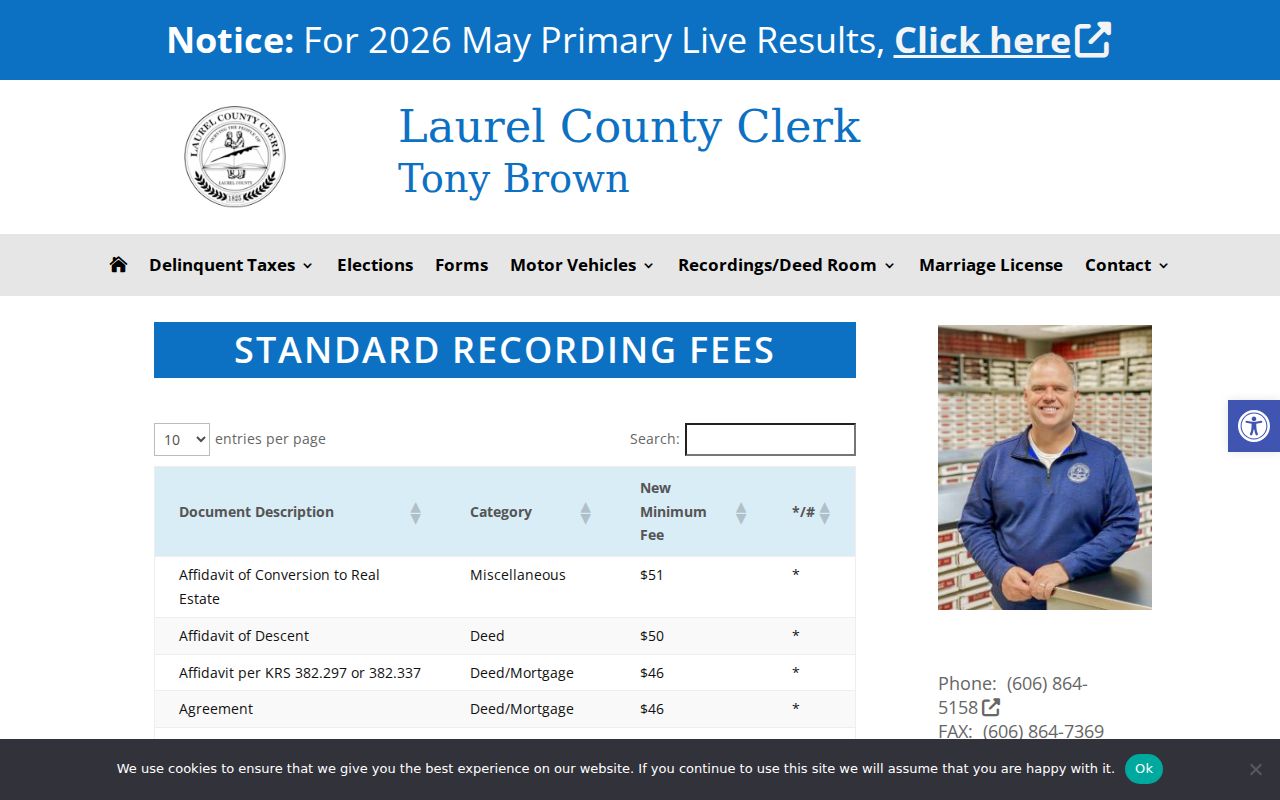
The clerk's fee schedule separates document categories and flags page overages. Check current amounts with the office before any new filing.
Corrections, Releases, and Laurel Title
A clean title search gathers more than deeds. Correction deeds can fix a recital or legal description, while mortgage and lien releases prove an earlier recorded claim was discharged. Lis pendens points to pending litigation over the land. A judgment or tax lien may need its own release before title clears. Match each release back to its original instrument.
Consideration amounts are clues, not appraisals. Kentucky's recording statutes and transfer-tax law govern stated consideration and its exemptions. A nominal amount often accompanies a family, estate, or corrective transfer and says nothing about current market value. Preserve the source's own label and context.
Laurel Property Fraud Alerts
The county clerk offers a free Property Fraud Alert service. Subscribers get a notice when a matching name appears on a new filing. The filing may be a new deed or mortgage. The alert never decides validity. A common name can trigger an unrelated notice, and a real concern still calls for reading the official instrument.
Open the deed or mortgage and compare its book and page, parcel description, signatures, and parties. Then contact the clerk. Keep the message or solicitation. Suspected forgery may also need law enforcement, legal counsel, and state consumer-protection help. The alert speeds review. It is no substitute for title insurance or a professional examination.
Request a Laurel County Deed Copy
Most deed-copy requests move through four channels. You can view and print through a registered eCCLIX account, inspect the office terminal, ask at the deed-room counter, or send a narrow written request. The clerk's open-records policy accepts requests in person, by mail, by fax, or through its listed email route. Include the document type, grantor and grantee, approximate date, and a book, page, or parcel clue. State the format and certification need.
Older chains may sit on microfilm at KDLA. Request the recorded plat too for a subdivision. The clerk's listed e-recording vendors handle new filings, not public searching. A certified copy authenticates the document as a clerk record. It does not certify that the chain of title is clear.
Recorded, not guaranteed. Laurel County deed records show instruments accepted for recording, but they are not a title opinion and may not reveal unrecorded interests.