
Trace Who Owns a Laurel County Property
Two offices hold the answer. The Laurel County PVA gives you the owner field and the parcel key. The Laurel County Clerk keeps the recorded conveyance. Treat the PVA entry as a lead. Treat the newest deed as the confirmation. That gap matters most right after a closing, since assessment data may still reflect the last certified roll rather than the buyer.
- Search the situs address through the Laurel PVA and copy the parcel number.
- Read the owner and mailing fields, then note any deed book, page, or sale reference.
- Search the county clerk's eCCLIX route for the newest deed naming that parcel or grantee.
- If the grantee is an entity, check its official Kentucky business filing rather than guessing a person.
This route answers a narrow question. It shows who owns the parcel in the public record. A mailing address proves nothing about where the land sits, and an owner name never guarantees the owner lives there.
Start With the Laurel County PVA Owner Field
The PVA's qPublic search works by owner name, property address, or parcel number. A parcel card can list the owner name, mailing and situs addresses, and assessed value. It may also show any exemption, sale details, physical characteristics, a photograph, and a sketch. For a quick answer, the owner field wins. The parcel number, meanwhile, ties one piece of land together across records. It links deed records, plats, and the tax roll.
| Parcel-card item | How it helps identify an owner |
|---|---|
| Owner name | Names the person or entity carried on the assessment roll |
| Mailing address | Shows where owner correspondence is sent |
| Situs address | Identifies the physical property being searched |
| Parcel number | Provides the cross-office property key |
| Sale or deed reference | Points toward the recorded transfer |
A qPublic result may display a data-upload date and a note about the last certified roll. Treat that date as evidence for the single result. It is not a promise about every Laurel parcel.
Situs and Mailing Addresses Solve Different Laurel County Clues
A mailing address on the tax roll may be a home, a business, or a post-office box far from the parcel. The situs address identifies the land itself. Before searching by name, write down the situs address, the owner mailing address, and the deed legal description as three separate items. That habit keeps a correspondence address from masquerading as ownership or boundary evidence.
- Owner of record
- The person or entity named in the official roll or recorded instrument being consulted.
- Situs
- The physical location assigned to the parcel.
- Mailing address
- The destination used for notices and correspondence.
- Grantee
- The party receiving an interest in a recorded deed.
- Title
- The legal ownership interest, which a simple public-record lookup does not fully adjudicate.
Laurel County mail may carry London, East Bernstadt, Lily, Keavy, Bush, or Pittsburg labels. A London ZIP never proves the parcel sits inside London.
Where Laurel County Property Ownership Appears
Each source answers a different slice. The assessment roll is fast. The recorded deed proves the transfer. A GIS map helps identify the parcel, and a business filing explains an entity name. Never let one quietly stand in for another.
| Source | Owner Info It Gives | Access |
|---|---|---|
| PVA assessment roll | Owner of record and mailing address | PVA/qPublic entry route |
| County clerk deed index | Grantee and the recorded instrument | eCCLIX account or office viewing |
| Kentucky business search | Entity filings, agent, and officers when available | Official SOS search |
| GIS context | Mapped location and boundary layers | PVA route or Kentucky GeoNet |
An occupant might be a relative, guest, property manager, or someone else entirely. Ownership sources identify an interest in land, not who is home. Put them to work for purchase diligence, estate matters, boundary questions, or fraud prevention.
Confirm the Laurel County Owner in the Latest Deed
Recorded deeds live with the Laurel County Clerk Recording and Deed Room. The clerk's eCCLIX service puts land records online for registered users. Anyone without an account can view the same records at the office. No official start year appears for the online index. So treat the archive as possibly incomplete.
Bring the PVA owner, the parcel number, the legal description, and any book/page citation into your deed search. Hunt for the most recent deed conveying that property to the named grantee. Then scan for later corrective deeds, commissioner deeds, or fiduciary deeds. These could change the answer. For help getting full copies, the Laurel County deed records guide walks through the request steps.
Note: A deed's recording date and the PVA roll refresh can differ, so note the date shown by each source.
The clerk's land-record page lays out both the online and in-person routes for confirming a Laurel County property owner from recorded deeds.
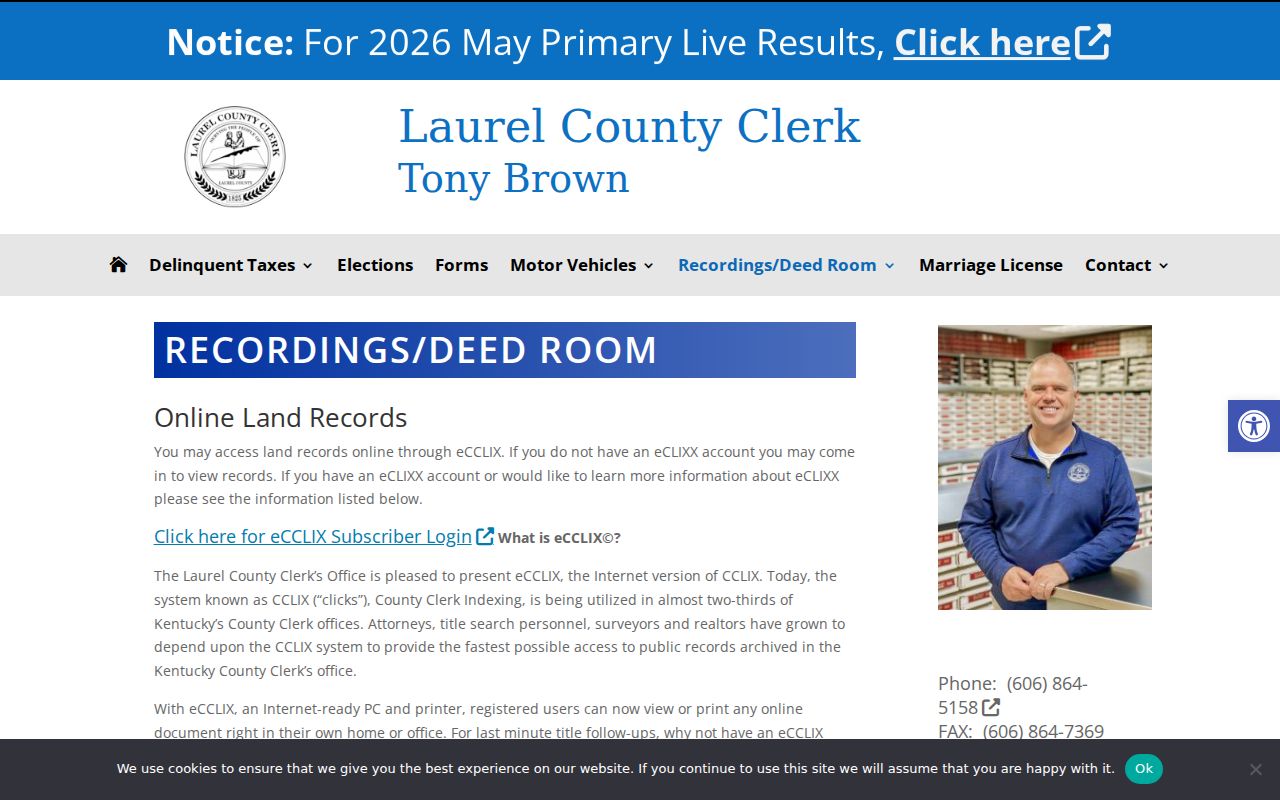
The page is only the doorway. The deed's grantee, legal description, and recording details supply the ownership evidence.
When a Laurel County Owner Is an LLC, Trust, or Estate
When the roll names an LLC, search the Kentucky Secretary of State business entity system by the exact entity name or organization number. A filing may show status, registered agent, officers, and available documents. Remember the point of that lookup. Those people are contacts for the legal entity named in the deed. They are not automatically the land's individual owners.
A trust may surface through a trustee's name and capacity. An estate can involve probate orders, fiduciary appointments, affidavits, or a fiduciary deed. Joint owners and life estates turn on deed language. Never collapse those interests into one person just because one name leads the assessment card.
London Records Can Add Owner Clues Without Proving Title
London building and electrical applications ask for owner, contractor, project, and site details. Planning, zoning, annexation, rezoning, and subdivision ordinances can also name developers or property owners. The city publishes no online permit-result index. The honest route is an address- or parcel-based request through the London open-records process.
Municipal files can link a person or entity to a project. They never replace the county deed. They shine when an owner search touches a permit, annexation parcel, named subdivision, or old street address.
A Laurel County Fraud Alert Is a Signal, Not a Verdict
The Laurel County Clerk offers a free Property Fraud Alert service. Subscribers get notified when a deed or mortgage is recorded under a name they watch. That makes it a solid prevention tool for Laurel County property records. Still, an alert never decides whether an instrument is valid. Pull the recorded deed itself. Compare the parties and legal description against what you expect. Call the clerk or law enforcement if forgery seems possible.
Treat alerts as one part of a habit. Pair them with periodic checks of the owner of record. Review the latest deed in Laurel County. A shared name, a spelling variant, or an unrelated filing can each trigger a notice. Verification is what keeps a warning from hardening into an unsupported ownership claim.
Safe at Home Does Not Hide Laurel County Real Estate
Kentucky's Safe at Home compliance guidance draws a careful line. The program masks a participant's address on many public-facing records, yet real-estate holdings stay exempt. So an agency or voter address may be hidden. The same person's parcel remains visible in Laurel County deed records and the tax roll. The distinction matters for anyone tracing ownership.
That visibility is not permission to target anyone. Use the least information your property question requires. Skip republishing personal contact details. Confirm the parcel and instrument before concluding anything about the owner of record.
What “Who Owns This Property” Cannot Establish
An owner name on the tax roll cannot tell you everything. It does not show who occupies a home. It cannot reveal an unrecorded dispute or guarantee every encumbrance surfaced. Keep the distinctions straight. An LLC agent is not the landowner. A taxpayer is not always the sole titleholder. A GIS map label is not a deed. When a purchase, an estate, or a boundary dispute turns on legal ownership in Laurel County, a title professional may be worth the call.
Lawful use. Laurel County owner records support property research and due diligence. Kentucky harassment and stalking laws prohibit using information to threaten, harass, or target anyone.
Sometimes the PVA and the newest deed disagree on the owner of record. Record both dates. Then ask each office about its update status. Do not just pick the name you prefer and ignore the conflict. The mismatch itself can point to a recent transfer, a corrected deed, or a parcel split. It could also flag an indexing error in Laurel County property records that deserves a closer look.