
Compare Laurel County Property Value Types
Kentucky law assesses property at fair cash value, with exemptions and classifications shaping the final figure. The Laurel PVA prepares that assessment. It does not set tax rates or collect the bill.
So a number means little on its own. Keep the label and the source attached. A parcel's appraisal, its tax roll entry, and its tax bill can differ, and each one answers a different question.
| Value | What It Is | Where |
|---|---|---|
| Assessed fair cash value | The PVA's annual valuation for the assessment system | Laurel PVA parcel record |
| Taxable value | The assessment after an applicable exemption or classification | PVA and tax record |
| Last sale price | The consideration tied to a past transfer, with its own date and conditions | Deed and PVA sale information |
| Current appraisal | An opinion for a stated date and purpose, not a standard county record field | Qualified appraiser's report |
A deed price from the past may reflect a nominal transfer, a family sale, a partial interest, a foreclosure, or simple age. Standing alone, it is weak evidence of today's market. An exemption works differently, reducing taxable exposure while leaving the fair-cash-value concept intact.
See What the Laurel PVA Counts in Property Value
The Laurel PVA real-property guidance counts land plus anything permanently attached: homes, offices, vacant tracts, farms, apartments, factories, restaurants, and manufactured housing. To build its assessments, the office draws on permit lists, mobile-home transfer records, owner reports, field measurements, photos, and physical specifications.
Each taxable parcel or interest gets assessed annually. Kentucky law also requires a physical examination at least once every four years. That four-year cycle is a recurring review duty. It is not a rule that values can only move once per cycle. Annual assessment work continues between examinations. A parcel's value can shift with new evidence in any year.
Know How Laurel County Estimates Property Value
The PVA's valuation guidance describes three standard approaches. A sales-comparison approach weighs comparable transfers. A cost approach tallies replacement cost minus depreciation. An income approach studies what income property can earn. Which evidence fits depends on the property, the data at hand, and the valuation date.
Remember that these are mass-assessment methods. One nearby sale does not set every Laurel County property value. Parcel characteristics, use, improvements, condition, and market evidence can push apparently similar property records apart.
Look Up a Laurel County Property Value
Start from the official PVA site to reach Property Search. The county controls that link and keeps it current. A deep URL to the Laurel qPublic screen may not survive changes on the county's side. The official entry point is the safer route. Before copying any value, tie the search result back to the exact parcel. The parcel number, not an address alone, is what anchors a value to the right record.
- Search the situs address through the Laurel PVA/qPublic path and verify the returned location.
- Copy the APN and value label, assessment year, exemption field, and any land or improvement breakdown shown.
- Read the sale-information date, price, deed book and page, grantor, and grantee when available.
- Use the clerk's deed reference to learn what the transaction actually conveyed.
- Record the access date and retain the PVA warning that a roll may change before certification.
- Assessed value
- The PVA valuation attached to the assessment record.
- Market value
- The amount a willing buyer and seller might agree upon under market conditions.
- Assessment ratio
- The relationship between assessed and market value; Kentucky's stated standard is full fair cash value.
- Consideration price
- The amount stated for a conveyance, which may not represent an ordinary open-market sale.
- Reassessment
- A later valuation review that can change the assessment record.
Compare Laurel County Property Value With Sale Data
A Laurel qPublic parcel report lives on the county's official host. It displays sale date, price, deed book, deed page, grantee, and grantor. Those fields let you move from the parcel card to the recorded instrument itself. The deed then shows whether the sale covered the whole tract or a partial interest. It may reveal family parties. It may reveal another condition that weakens a simple price comparison.
The same report includes a photo, a sketch, property characteristics, and a homestead-deduction field. Useful as those are for identifying the assessed property, they prove no boundary. They prove no current condition. They prove no present sale value.
Account for Laurel County Assessed Value Timing
One county parcel report carries a June 5, 2025 upload timestamp and states that its assessment comes from the last certified roll, subject to change before the next one. That timestamp belongs to the individual report display. It is no promise of a countywide refresh. The durable habit is simpler: save the roll year behind any figure you rely on.
Timing explains many apparent gaps. A recent deed can beat the PVA's update. An old sale price can linger on a card long after the market moves. Compare dates before concluding that anything is wrong.
Separate Laurel County Property Value From Exemptions
The Laurel PVA publishes homestead-exemption guidance along with downloadable forms. The local page lists a $49,100 exemption amount for 2025 and 2026. It applies to qualifying age or disability claims. That figure is time-sensitive. It shapes taxable exposure only. Never subtract it from a market opinion to guess a sale price.
The PVA does not set county, city, school, or district tax rates either. Assessment times applicable rates yields the bill. Exemptions and other rules are applied along the way. For due dates, payment, and appeal mechanics, turn to the property-tax records. Do not treat a value overview as a bill calculator.
Use London Zoning as Laurel County Property Value Context
London Ordinance 2025-17 rezoned Chestnut Place LLC property at KY 1006 and KY 363. The change moved it from R-2 to C-2. That is a dated land-use fact. Pair it with the current PVA card, deed, and map. It does not prove the parcel rose or fell in value.
The same caution covers annexation, permits, historic status, and road changes. Any of these may inform assessment inputs or explain context. But the existence of a city record alone supports no valuation conclusion. A researcher should resist leaping from rezoning to price.
Distinguish Laurel County Value From the Tax Bill
The Laurel sheriff's property-tax portal and the PVA record answer different questions. The PVA supplies the assessment. Taxing bodies set the rates. The sheriff handles collection. A bill can shift because of rates, districts, penalties, or exemptions even when the assessed value itself barely moves. The Laurel County Sheriff property-tax page presents that collection side of the ledger, and it confirms the separate route a bill travels.
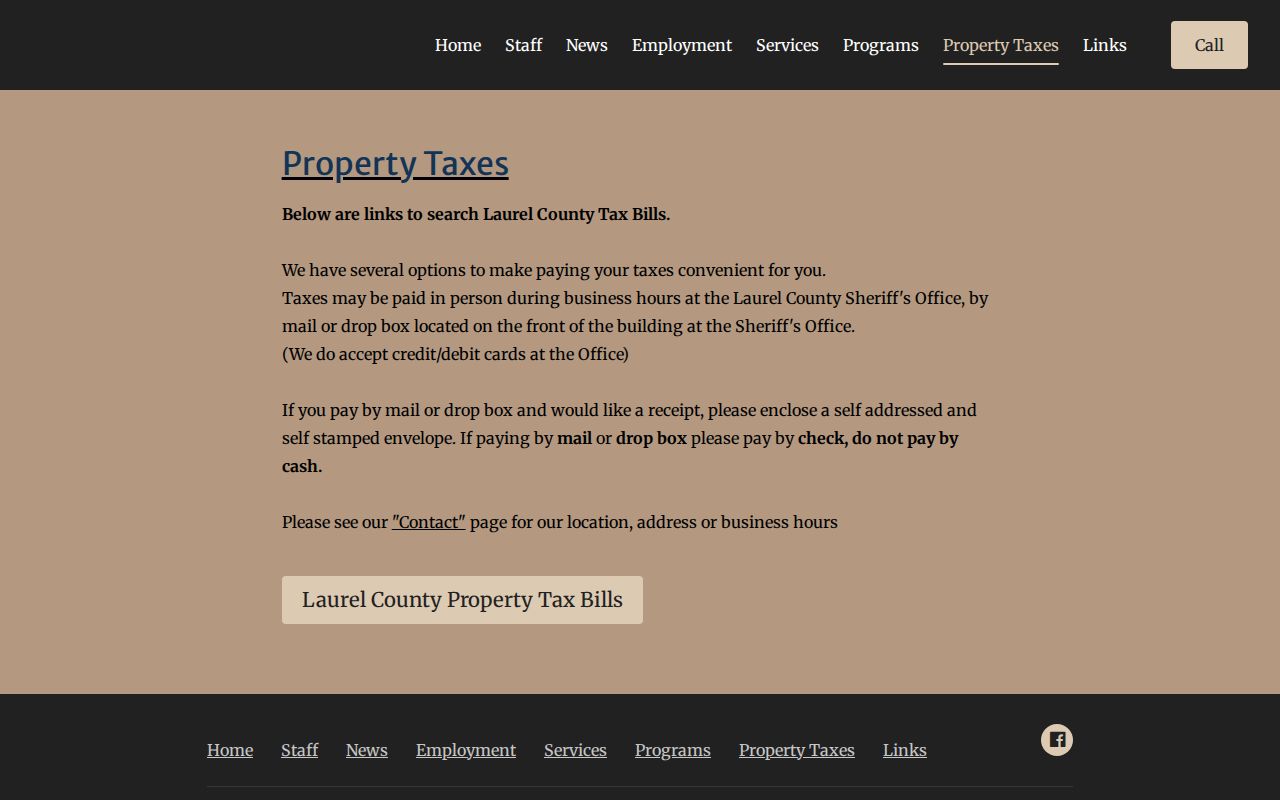
Collection is the page's job, not valuation. Treat it as a companion to the PVA record rather than a substitute for the assessor's numbers.
Know What a Laurel County Assessed Value Cannot Prove
An assessed value in Laurel County comes from a mass-appraisal system built for taxation. That number cannot promise what a buyer will pay. It also cannot tell you what a lender will accept. It cannot say what repairs will cost. And it cannot reveal what legal rights attach to the parcel. An assessment carries its own effective date. Because of that, it may lag behind the latest deed or sale on record with the county.
Value versus price. A Laurel County assessed value is not a sale guarantee or individual appraisal; use a qualified appraisal for a specific transaction.